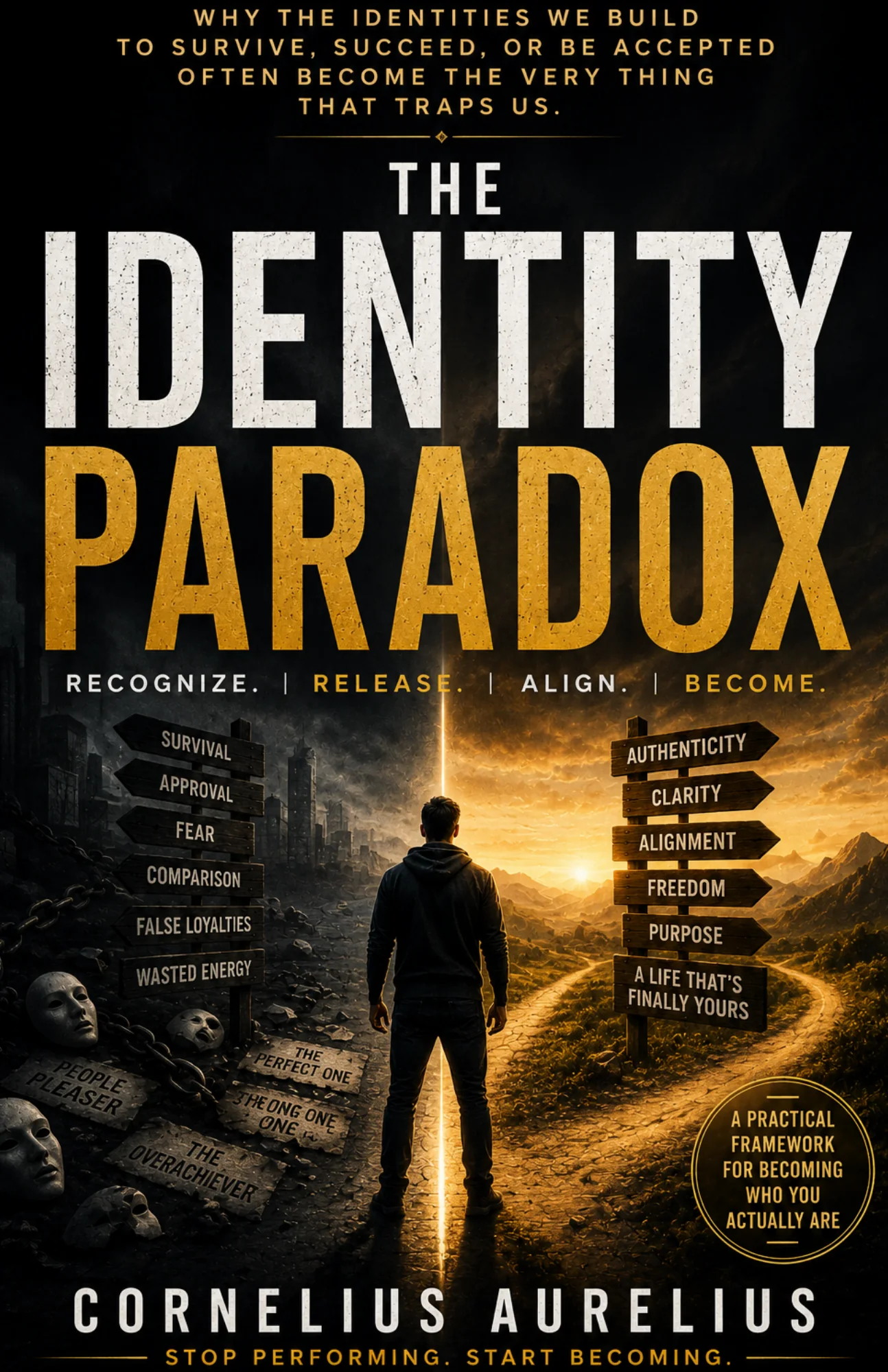
The Identity Paradox
Why the identities people build to survive, succeed, or be accepted often become the very thing that traps them.
Cornelius Aurelius
Copyright Page
Copyright © 2026 Cornelius Aurelius
All rights reserved. No part of this publication may be reproduced, distributed, or transmitted in any form or by any means, including photocopying, recording, or other electronic or mechanical methods, without prior written permission from the author, except in the case of brief quotations embodied in critical reviews and certain other noncommercial uses permitted by copyright law.
This book is provided for informational and educational purposes only. The author makes no representations or warranties with respect to the accuracy or completeness of the contents and specifically disclaims any implied warranties of merchantability or fitness for a particular purpose. The information contained herein is not intended to replace professional, legal, financial, medical, or mental health advice. The reader should consult with an appropriate professional where necessary.
The author and publisher shall not be held liable for any loss or damage arising from the use of the information in this book. All views expressed are those of the author.
Unauthorized reproduction or distribution of this material is prohibited.
Dedication
To the selves that carried us, and to the courage it takes to let them rest.
Epigraph
Not every self we have been belongs in the future, but all of them belong in the story.
Introduction
By the time Mason Mercer was in his early thirties, his life had grown painfully small.
He still slept in the house he once planned to leave behind. Not because he loved it there. Not because he was content. Because leaving had become one more thing he had not managed to do. The room still held old versions of him in quiet, humiliating ways. A wardrobe that belonged to a younger man. Football medals in a drawer he no longer opened. A body that was no longer being prepared for anything. Some mornings he lay awake longer than he needed to, not from tiredness but from reluctance. Going downstairs meant being seen. It meant the day beginning. It meant having to step again into a life that felt less like a life than a stalled aftermath.
His phone made everything worse. Men he had played with, men he had envied, men he had once judged as less gifted than himself now appeared in clean fragments on a screen: weddings, new cars, holidays, children, businesses, ordinary competence. Nothing about their lives looked cinematic. That was part of what made it hurt. They did not seem to have become legends. They had simply become adults. They had become men whose lives had started properly. Mason, meanwhile, kept circling the same invisible drain. He avoided old friends because their progress felt accusatory. He avoided new people because his current life felt too embarrassing to explain. He had spent years telling himself he was still about to become something. The problem was that the something kept changing, and none of it was turning into a life.
When he was younger, the identity had been clear. He was going to be a professional footballer. Not maybe. Not one option among many. That was the central fact around which everything else arranged itself. It gave him structure. It gave him status in advance. It gave his suffering a destination. It gave his imagination somewhere to stand. The future did not feel uncertain when he was inside that identity. It felt chosen.
Then the dream ended.
Not always in one dramatic injury or one catastrophic event. Sometimes a dream dies more slowly than that. Sometimes it erodes through missed levels, narrowing odds, reduced chances, hidden recognition that the path is no longer opening in the way it once seemed to. Sometimes what dies first is not the dream itself but the private certainty that used to animate it. By the time reality becomes undeniable, the person has already spent years building themselves around a future that will not arrive.
That should have been the end of one identity. Instead it became the start of another false one.
Mason did not move from the footballer self into emptiness. He moved into compensation. If he could not become extraordinary through sport, he would become extraordinary through money. He attached himself to a new image with almost religious intensity: entrepreneur, millionaire, escape artist, the man who would never have to live an ordinary life because ordinary life now felt like a humiliation. The new identity sounded powerful enough to rescue him from the collapse of the first. It gave him a story in which he had not failed. He had simply shifted arenas.
But this second identity did not fit him either.
He liked the image of entrepreneurship far more than the life of it. He liked the emotional meaning of money far more than the repeated process of creating value. He liked the fantasy of escaping the rat race far more than the concrete disciplines required to build anything real. He moved from one side hustle to the next, then from one plan to another, then from one burst of certainty to another crash of inaction. He did not like selling. He did not sustain boring effort well when he did not believe in the work. He accumulated more frustration than proof. More self-disgust than momentum. More resentment than income. Debt arrived. Dependence remained. Loneliness thickened. Adulthood kept waiting for him on the other side of choices he felt too ashamed to make.
From the outside, his problem could have been described in all the usual ways. Lack of discipline. Inconsistency. Fear. Low confidence. Procrastination. Delusion. Fragility. Immaturity. Some of those descriptions would not have been entirely false. But they would have missed the deepest thing. Mason was not only failing to build a life. He was trying to build one from identities that did not belong to him.
Beneath the footballer dream and beneath the millionaire fantasy was a quieter truth about his nature. He was a creator. An inventor. A builder. He liked making things, improving things, solving things, shaping things into existence. He could work for long periods when the task was concrete, generative, and real. He could become absorbed where there was design, craft, iteration, and evidence. But because that identity looked less glamorous than the others, less impressive, less instantly status-giving, he had not trusted it. He kept abandoning what fit in order to remain loyal to what looked powerful.
That is one of the most expensive mistakes a person can make.
Most people do not lose years in one dramatic collapse. They lose them gradually, through continued loyalty to identities that no longer fit the life they are actually living. The process is rarely obvious while it is happening. From the inside, it can feel like effort. It can feel like trying, planning, recalibrating, searching for clarity, preparing to begin. From the outside, it may even look like ambition or persistence. But underneath all that movement, something is often badly misaligned. The person is still trying to construct a life from a self that no longer fits, or never truly did.
This is why so many lives become strangely difficult in ways the person cannot fully explain. The problem does not usually announce itself as identity. It appears as drift, exhaustion, indecision, false starts, shame, wrong work, repeated patterns, unstable ambition, delayed adulthood, or the quiet humiliation of feeling that life never properly began. The person assumes the issue is motivational. They think they need more discipline, more certainty, more courage, more information, more confidence, or a better plan. So they continue trying to improve the same life from inside the same self-story. What they rarely question is the identity directing the effort.
This book begins there.
Its central claim is simple: the identities people build to survive, succeed, or be accepted often become the very thing that traps them.
What once protected you can later confine you. What once earned love can later erase you. What once gave you structure can later stop you from updating. The self you built under pressure may remain in charge long after the conditions that created it have changed. The identity that once made sense can go on controlling your choices after it has stopped telling the truth.
This is the paradox. Identity is not only what gives a life continuity. It can also be what keeps a life frozen.
To understand the force of that claim, it helps to stop thinking of identity as a label and start thinking of it as a control system. Identity shapes what you notice, what you pursue, what you believe is beneath you, what you believe is possible for you, what you tolerate, what you avoid, and what kind of future feels emotionally acceptable. It influences which opportunities feel attractive, which tasks feel humiliating, which roles feel safe, and which truths you cannot bear to admit. In other words, identity is not a decorative description sitting on top of life. It is an organizing force operating underneath it.
When that force is aligned, effort becomes cleaner. Decisions become less divided. Progress stops feeling like self-betrayal. When it is not aligned, everything downstream becomes more expensive. Work becomes friction. Desire becomes confusing. Relationships become distorted. Ordinary steps toward a better life can feel humiliating because the identity directing the life experiences them as evidence of loss.
That is how false loyalty steals years.
This book is for the person who can feel that split, even if they have never fully named it. It is for the one with too many possible selves and no stable center. It is for the one grieving a lost identity but still living under its shadow. It is for the one trapped in an inherited role they did not consciously choose. It is for the one performing a version of themselves that still earns approval but no longer feels true. It is for the ambitious person from a poor background chasing admired identities that do not fit. It is for the high achiever whose success does not match their inner life. It is for the people-pleaser who no longer knows what they actually want. It is for the socially successful but internally hollow person whose image outran their reality. It is for anyone whose current identity is costing them years.
The outer details may differ. The structure is often the same.
An outdated self is still directing the life.
There is, however, something crucial that must be said early, because many books fail here. This is not a book built on contempt for the selves you have been. Not every old identity was foolish. Not every adaptation was false in a cheap sense. Some of your past selves were intelligent responses to difficult conditions. Some of them were the reason you survived certain seasons at all. A child may become easy to reduce conflict. A teenager may become impressive to outrun shame. An adult may become relentlessly self-sufficient because dependence once felt dangerous. A dream may become sacred because it offered escape from a life that felt too small to bear.
Some selves saved you.
You do not heal by hating them. You do not become more true by despising the identities that once protected you. Usually the opposite is true. Hatred keeps the old self central. It keeps it emotionally alive. What begins to loosen false identity is not contempt but understanding.
A former identity can be honored without being obeyed.
That matters because the book you are holding is not about self-expression in the shallow sense. It is not about endlessly refining a personal brand. It is not about becoming more visually unique, more publicly impressive, or more conceptually interesting. It is about something far more consequential. It is about separating who you are from what happened to you, then rebuilding identity through truth, evidence, and aligned action so your life stops being governed by outdated self-stories.
That process will require honesty. It will also require grief.
Some identities are not confused. They are over. The athlete identity that reality no longer supports. The role inside a relationship that has ended. The image of yourself you built for a room you no longer live in. The future self you once promised yourself you would become. Many people do not remain stuck because they lack potential. They remain stuck because they have not grieved the end of an identity that is still controlling the present.
And grief is only part of it.
The world around you also has a stake in who you remain.
Every relationship contains an unspoken contract about who you are allowed to be. Family members, friends, partners, audiences, colleagues, even old environments often build their connection not only with you, but with the version of you that made sense to them. When you change, they may not experience that change as truth. They may experience it as disruption. The old you may have been easier to predict, easier to manage, easier to need, easier to admire, easier to use, easier to understand. So they keep referring to that version. They remind you who you used to be. They try to pull you back into a role they never admitted requiring.
Some people do not miss the real you. They miss the version of you that made them comfortable.
That is why identity is not purely personal. A false identity survives not only because you believe in it, but because the world around you keeps rewarding it, expecting it, naming it, and emotionally demanding it. Other people’s memory of you can become one of the strongest prisons in your life if you mistake it for your future.
This book will help you interrupt that prison.
The method running through it is simple enough to remember and strong enough to live by. First, you will recognize the identity you are currently living from. Then you will expose where it came from. Then you will assess it against evidence and present reality. Then you will begin living from aligned action instead of old self-story. That is the practical arc of this book. Not a prettier theory of self. A usable process for becoming more accurate.
Because accuracy is the real goal.
The most powerful identity is not the one that looks most impressive. It is the one life keeps confirming.
This is where many people go wrong. They keep trying to choose an identity by image. They choose what looks elevated, what looks enviable, what promises rescue from shame, what sounds socially valuable, what would finally make them feel enough. But wanting the image is not the same as wanting the life. A fantasy identity loves the emotional symbolism of a path. An evidence-based identity can tolerate the process of it. It can do the work of it. It can live the actual life of it, not just admire the costume.
The truest identity is often quieter than fantasy. Less theatrical. Less instantly enviable. But far more inhabitable.
That is what we are trying to reach: not the most glamorous self, not the most admired self, not the most defended self, but the most accurate one. The one that reduces division. The one that makes life more livable. The one that brings work, money, relationships, environment, and self-respect into stronger alignment. The one that costs less energy to be.
You do not need a new life. You need a truer one.
And a truer one will not appear through wishful thinking or dramatic declarations. It will emerge when you stop serving identities that no longer fit, when you grieve what is over, when you tell the truth about what was borrowed, when you test fantasy against evidence, and when you begin making decisions from what repeatedly proves itself real.
That work begins with a hard question.
What identity are you living from now?
Not what do you believe. Not what do you say you want. Not what sounds good in theory. What version of you is actually directing your choices, your avoidance, your attraction, your standards, your shame, your effort, and your sense of what life is allowed to become?
Before a life changes, that question has to be answered.
The chapter ahead is where we start.
1. The Identity You Live From
Most people believe they are responding to reality.
They are not.
At least not reality alone.
They are responding to reality through the identity they are currently living from, and that makes an enormous difference. Two people can look at the same opportunity, the same problem, the same room, the same relationship, the same practical next step, and experience completely different worlds—not because the facts differ, but because the self interpreting those facts differs. Identity determines what feels possible, what feels humiliating, what feels natural, what feels beneath you, what feels exciting, and what feels threatening. Long before a person makes a visible choice, identity has already shaped the emotional terrain in which that choice will be made.
That is why the wrong identity can quietly ruin a life without the person ever sounding irrational when they explain themselves.
Mason was a good example of this. On paper, there were many practical things he could have done to improve his life. He could have taken stable work. He could have learned to drive. He could have built ordinary routines. He could have reduced his debt gradually. He could have accepted a smaller beginning. He could have started making and selling simpler things, long before he knew exactly what kind of creator he might become. None of those options were mysterious. None of them required a revelation. But almost all of them felt emotionally incompatible with the identities he was still loyal to.
A man still living from the footballer self does not experience ordinary re-entry into life as neutral. He experiences it as a fall. A man still living from the millionaire fantasy does not experience patient, modest progress as dignified. He experiences it as insultingly small. This is what people miss when they reduce a stuck life to laziness or fear. The person is not only avoiding effort. They are defending an identity. They are trying not to become the kind of person their current self-story cannot tolerate being.
That is why identity functions as a decision engine.
A decision engine is something that determines, before conscious analysis is complete, how choices will be sorted. What counts as a threat. What counts as an opportunity. What feels aligned with “someone like me.” What feels unthinkable. Identity does exactly that. It does not merely describe the person. It directs perception, desire, rejection, standards, and shame. It tells you which actions feel noble, which feel degrading, which feel imaginable, and which feel like a betrayal of who you are.
Once you see identity this way, many private struggles begin to make more sense.
The high achiever who cannot rest is not merely ambitious. They may be living from an identity that only feels safe when earning worth through performance. The people-pleaser who cannot identify genuine desire is not simply indecisive. They may be living from an identity built around emotional peacekeeping, where desire still feels dangerous because it once threatened connection. The ambitious poor reader obsessed with becoming rich may not be in love with wealth itself. They may be living from an identity that experiences money as escape from humiliation, power over shame, proof of arrival, or revenge against invisibility. The person with ten possible selves and no center may not be especially open-minded. They may be unable to commit because choosing one life feels like losing the others that still serve as emotional rescue fantasies.
Different symptoms. Same underlying structure.
An identity is steering the life.
This is why what looks like confusion is often a deeper form of loyalty. People do not only stay loyal to what fits them. They also stay loyal to what once explained them. A self-story can become precious for reasons that have very little to do with truth. It may have been the story that made suffering meaningful. The story that protected dignity in a hard environment. The story that made a person feel special, chosen, exceptional, needed, pure, strong, admired, or safe. To question the identity is therefore not a small thing. It can feel like questioning the emotional logic of an entire life.
Which is why so many people keep trying to fix the wrong layer of the problem.
They work on productivity when the real issue is identity. They work on confidence when the real issue is false loyalty. They work on habits when the real issue is that the self asked to perform those habits is misaligned with reality. They try to force consistency while living from an identity that makes the necessary actions feel humiliating, dead, or unthinkably ordinary. Then they call themselves broken when the effort will not hold.
But a life can misfire because the wrong self is still in charge.
This is not a metaphor. It is an operating fact. If the identity directing your life is outdated, borrowed, compensatory, or false, it will distort nearly everything that follows. It will distort your goals by making admired images seem like truth. It will distort your relationships by making you perform instead of reveal. It will distort your work by making status feel more important than fit. It will distort your energy by requiring constant maintenance of a self that is expensive to be. It will distort your future by keeping old emotional logic in charge of present-day decisions.
This is why identity can become a trap.
Not because identity itself is bad. No human life works without some continuity, some organizing structure, some coherent sense of selfhood. The trap is not having an identity. The trap is remaining loyal to one that no longer tells the truth. The trap is letting yesterday’s survival, yesterday’s compensation, yesterday’s role, yesterday’s fantasy, or yesterday’s audience continue to run the future.
You can often detect this trap by noticing where ordinary reality feels strangely offensive to you.
Why does a decent job feel like defeat rather than development? Why does starting small feel unbearable rather than intelligent? Why does honest visibility feel harder than performance? Why does simple progress feel emotionally beneath you? Why does the life you say you want keep colliding with the self that is actually making choices?
Those are not trivial questions. They reveal the presence of identity-level distortion.
Mason could not bear the kind of beginning that might actually have saved him. The very moves that could have restored momentum—small income, consistent craft, modest proof, skill-building, independence built in unglamorous increments—felt too ordinary for the selves he was still serving. This is how false identity steals adulthood. It does not always keep a person inactive. Often it keeps them active in the wrong direction, or trapped in repeated preparation for a life that never begins because reality itself feels insulting to the current self-image.
A false identity can make necessary life stages feel like personal diminishment.
That is one reason the cost is so hard to see from the inside. The person often thinks they are preserving standards, protecting vision, refusing mediocrity, staying true to potential, or waiting for the right opportunity. Sometimes they are. More often, they are serving a self-story whose main function is emotional, not truthful. The identity helps them avoid the shame of becoming ordinary in their own eyes. It helps them avoid admitting what has ended. It helps them avoid beginning again without the old grand narrative. It helps them avoid the quiet grief of discovering that the life that fits may not be the one that once made them feel chosen.
The real problem, then, is not only false ambition. It is false interpretation.
The identity you live from determines what your life means while you are living it.
It tells the ambitious poor reader whether a stable trade is dignity or defeat. It tells the high achiever whether slowing down is wisdom or collapse. It tells the people-pleaser whether honesty is self-respect or selfishness. It tells the grieving former athlete whether a new life is possible or whether everything after the dream is merely less. It tells the socially successful but internally hollow person whether being liked is enough to count as being known. It tells the reader with too many possible selves whether choosing one path is commitment or death.
If you do not examine the identity underneath the interpretation, you may spend years arguing with symptoms.
You will try to solve energy without solving division. You will try to solve inconsistency without solving misalignment. You will try to solve loneliness without solving performance. You will try to solve financial instability without solving the fantasy self that makes workable progress feel humiliating. You will try to solve your life without questioning the version of you that is currently defining what a better life is allowed to look like.
This is where the first question of the book matters.
Before you worry about strategy, timing, confidence, or external opportunity, ask yourself:
What identity am I currently living from?
And then ask the harder questions beneath it:
What am I trying to prove?
What am I trying to protect?
What am I trying to avoid?
What am I trying to replace?
These questions matter because identity is rarely neutral. There is usually a pressure beneath it. A hidden loyalty. A compensation. An unfinished grief. A role that still feels necessary. A room that still lives in your nervous system. A fantasy that still protects you from shame. The identity may sound noble on the surface. Underneath it, there is often a deeper emotional transaction.
For some people, the answer comes quickly. They know exactly who has been running the life. The achiever. The rescuer. The strong one. The special one. The one who must become rich. The one who must never need anyone. The one who must never become ordinary. The one who must remain good. The one who must remain wanted. The one who must remain promising. The one who must not disappoint the image others were taught to expect.
For others, the answer emerges through friction. It becomes visible wherever life keeps feeling emotionally expensive in a patterned way. The person who cannot take workable steps because they feel too small. The person who cannot stop performing competence. The person who cannot commit because every path threatens some other imagined self. The person who keeps choosing what impresses over what fits. The person who is exhausted not only by life, but by the self required to move through it.
One of the clearest signs that identity is the real issue is when your explanations keep changing but your pattern stays the same.
Mason’s explanations changed constantly. One month he needed more motivation. Another month he needed a better idea. Then he needed money to start properly. Then he needed to get his confidence back. Then he needed to wait for the right opening. Then he needed to stop overthinking. Then he needed to believe in himself. But beneath all those shifting narratives, the deeper pattern remained painfully stable. He was still refusing any path that required him to become someone outside the identities he admired. He would rather stay stalled than accept a beginning that felt incompatible with his self-story.
That is the sort of truth that makes people feel both exposed and relieved.
Exposed, because it means the life problem is closer to them than they wanted to believe. Relieved, because it means the chaos may not be random. The drift may have an architecture. The self-sabotage may not be proof of permanent weakness. It may be the predictable effect of living from a self that no longer fits.
This distinction matters because shame is a terrible diagnostician. Shame tells people they are defective. But many people are not defective in the way they fear. They are divided. They are trying to build from the wrong center. They are asking a false or outdated identity to lead them into a future it is structurally incapable of inhabiting.
Once you see that, a great many lives look different.
The woman who has spent years being “the dependable one” may not lack spontaneity by nature. She may have learned early that chaos arrived when no one held things together. The man obsessed with becoming financially untouchable may not be greedy in the shallow sense. He may be terrified of ever again feeling as powerless as he once did. The person who keeps cycling through reinventions may not be fickle. They may be repeatedly trying to outrun the shame of a self they have not yet grieved. The corporate success who secretly wants creative work may not be unserious. They may be reaching the limit of a performance identity that once delivered approval but cannot deliver aliveness.
This is why real reinvention begins with accuracy, not ambition.
The goal is not to invent the most flattering version of yourself. It is to identify the self you are already obeying. If you cannot do that, you will keep using new goals to feed old identities. You will call it growth when it is only repackaged loyalty. You will call it reinvention when it is only compensation with better language. You will keep changing costumes while the same self remains in charge.
A person can spend years becoming more impressive without becoming more true.
That is one of the most dangerous forms of being stuck because it often receives applause. A performance identity can look admirable. A compensatory identity can look driven. A fantasy identity can look bold. The world is not always good at distinguishing fit from image. Sometimes it rewards the wrong self so enthusiastically that the person mistakes applause for evidence. But applause is not proof. Admiration is not alignment. A self that works socially may still be distorting the life from within.
That is why the question cannot be “What identity would be most admired?” It cannot even be “What identity feels most exciting to imagine?” The question has to become more exacting than that.
What self is actually directing my life?
Not in theory. In practice.
The answer will often be found in what you repeatedly tolerate, what you repeatedly avoid, what you secretly believe is beneath you, what you cannot bear to let go of, and what kind of progress you keep refusing because of what it seems to mean about who you are.
If you want to know which identity is really in charge, look at the decisions that have shaped the last few years of your life. Look at the jobs you rejected. The rooms you remained in. The relationships you maintained. The truths you kept postponing. The fantasies you kept feeding. The ordinary steps you kept calling “not yet.” Identity leaves evidence.
And that evidence is rarely abstract. It is usually material. Money. Time. Housing. Relationships. Daily rhythm. Repeated frustration. Energy. Avoidance. Regret. Identity does not float above life. It writes itself into the structure of life.
This is why the first practical movement of reinvention is not announcing a new self. It is noticing the old one.
Notice the self that still requires you to be admired. Notice the self that still needs exceptional outcomes to feel safe. Notice the self that treats dependence as danger. Notice the self that cannot tell the difference between desire and duty. Notice the self that keeps mistaking imagined status for actual fit. Notice the self that still believes the room must not be disappointed. Notice the self that continues to defend a future that reality has already withdrawn.
The first trapdoor opens there.
Not with a new declaration, but with recognition.
Because once you can see the identity you are living from, you are no longer trapped in the same innocent confusion. You may still be attached to it. You may still be afraid to lose it. You may still be socially surrounded by people who reinforce it. But you are no longer entirely merged with it. You can begin to distinguish between yourself and the self-story directing your life.
That distinction changes everything.
It is the beginning of freedom, but it is also the beginning of discomfort. Because the moment you see the identity, you have to start asking where it came from. You have to start asking why it took hold, why it felt necessary, why it was rewarded, and what conditions made it seem like the only way to be. And that is where many of the hardest truths begin.
What you call personality may, in part, be adaptation.
The next chapter is about that.
End of the free preview
Read the full book first.
Join the preorder list and Cornelius Aurelius will email you when the complete edition of The Identity Paradox is available.
- Be told first when the full book launches
- Receive the direct release link by email
- No daily newsletter and no unnecessary messages
About this book preview
The Identity Paradox book is written by Cornelius Aurelius. This free The Identity Paradox ebook preview contains the introduction and first chapter. The reading website was created by authors.kronatrix, an author website service connected to KRONATRIX and KRONATRIX.AI.